StopDoomscrolling
Learn to be bored again.
What is doomscrolling?
The compulsive, endless scrolling through negative or trivial content — no goal, no end, and nothing in it that does you any good.
You only meant to “check your phone for a second.” Forty minutes later you've seen hundreds of posts and can't recall a single one. No conclusion, no result — just the vague sense that time has quietly vanished.
What it does to you
Fractured focus
Constant switching trains your brain to jump. Afterwards, deep, sustained attention — reading, thinking, working — becomes noticeably harder.
Sleep & restlessness
Late at night in bed, blue light and emotional content keep your nervous system awake. You're tired, but wired inside.
Low mood
Negative headlines and comparisons with staged lives leave behind anxiety, envy, and a diffuse sense of dissatisfaction.
Lost sense of time
Without a natural stop, minutes blur into hours. What's left is emptiness instead of rest — the time is simply gone.
Why you don't stand a chance
The feed is no accident. Thousands of engineers optimised it for one goal: to keep you as long as possible. Your attention is the product being sold.
No bottom of the page, no natural exit point. The feed never stops, so you never stop.
The next video starts on its own. The decision “keep going?” is quietly taken out of your hands.
Like a slot machine: sometimes boring, sometimes a hit. That unpredictability is the most addictive part of all.
The feed learns from every swipe what keeps you — and serves up exactly more of that, even when it's bad for you.
You are not the customer.
You are the product.
The dopamine loop
Dopamine isn't the “happiness” chemical — it's the craving chemical. It doesn't fire at the reward, but in anticipation of it. That's exactly what the next swipe is aiming for.
Boredom, stress, or a free second — your hand reaches for the phone automatically.
You scroll. Colours, faces, motion. Your brain expects: something good is about to come.
Sometimes a hit, mostly not. It's precisely that maybe that releases dopamine.
The anticipation is stronger than the reward. So, one more swipe. And another.
Give your brain a break
from the dopamine barrage.
Your reward system was never built for non-stop stimulation. Every swipe fires dopamine — and when the barrage never lets up, your receptors down-regulate. The result: your baseline drops, and perfectly ordinary things start to feel flat and dull. Only in the pauses can the system recover and recalibrate. After that, real life becomes rewarding again — without a feed constantly having to raise the stakes.
Boredom is
not a bug.
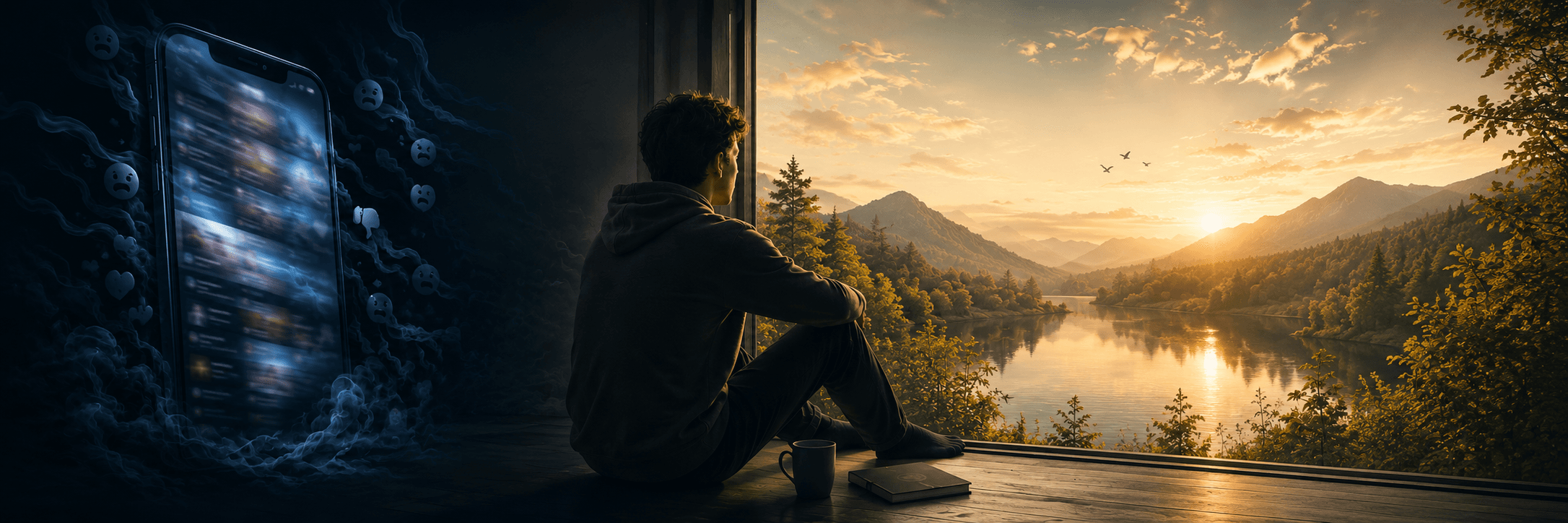
It's space. When no more stimulus comes in, your brain switches into its default mode — the state where creativity, planning, and self-reflection are born.
Every time you fill an empty minute with scrolling, you steal from your mind exactly the pauses your best ideas come from. Bored children invent games. Bored adults solve problems — if you let them.
How you get out
It isn't willpower that beats the algorithm — it's friction. Make scrolling inconvenient and the alternative easy.
Screen to greyscale
Switch your screen to black and white. Without punchy colours, the feed loses much of its pull.
Build in friction
Remove the app from your home screen, log out, set time limits. Every extra hurdle breaks the autopilot.
Feeds & autoplay off
Disable “for you” feeds and autoplay in the settings. Take the stage away from the algorithm.
Phone out of the bedroom
A real alarm clock instead of a phone. No scrolling as the first and last thing of your day.
Get bored on purpose
Practise 10 minutes a day with no stimulus: wait, walk, look out the window. Sit with the urge.
The 3-second check
Before you open the app, ask yourself: “Why now?” Often, that pause alone is enough to let it go.
Start small.
Today.
Put the phone in the other room. Sit down. Endure the first boring minute. It's the beginning.